Elija un disipador de calor en 8 pasos, desde vatios y temperatura ambiente hasta un número de pieza liberado, con tablas de decisión. BQUQ (ISO9001, Dongguan) cotiza en 12 h.
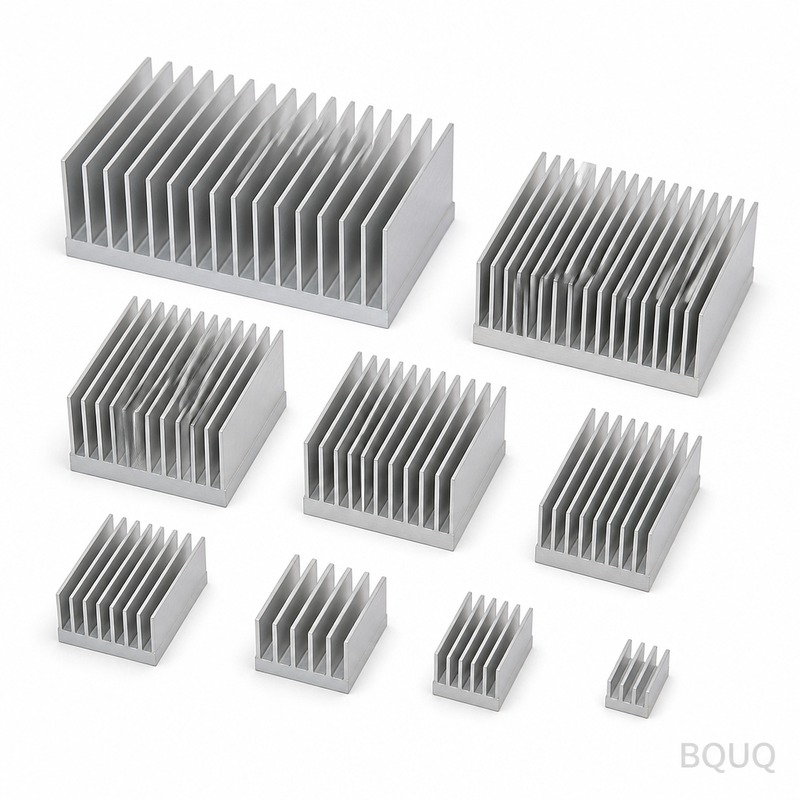
Selección de disipadores de calor en 8 pasos: de vatios a número de pieza
Seleccionar un disipador de calor es un embudo de ocho pasos que comienza con los vatios y termina con un número de pieza: defina la potencia disipada, fije los límites de temperatura, calcule la resistencia requerida, elija el modo de enfriamiento, seleccione el proceso de construcción, dimensione la geometría, verifique mediante medición y libere con datos de inspección. Omitir el primer paso — conocer realmente la potencia — es la causa de más disipadores incorrectos que cualquier otra razón.
Los ingenieros tienden a ir directamente al catálogo, buscando un patrón de aletas atractivo que se ajuste al espacio disponible. Eso solo funciona cuando el presupuesto térmico ya se ha realizado. Este flujo de trabajo obliga a hacer primero el presupuesto, luego lo mapea sobre la realidad de fabricación de construcción extruida, mecanizada por CNC y estampada, y finaliza con la verificación que convierte una suposición en una pieza liberada.
Pasos 1–2: Fijar la potencia y las temperaturas
El paso 1 es la disipación en el peor caso medida o simulada — no la cifra típica de la hoja de datos ni la potencia de marketing. Si el producto no se ha medido, construya primero el prototipo o use el número máximo sostenido del proveedor más un margen; nuestra guía TDP vs potencia medida muestra cuán mal las cifras nominales subestiman las piezas reales. El paso 2 fija tres temperaturas: la temperatura máxima de unión o de la carcasa del datasheet del componente, la temperatura ambiente del peor caso a lo largo de toda la vida del producto (incluyendo luz solar, altitud y equipos vecinos), y el aumento de temperatura objetivo que mantiene los márgenes de fiabilidad.
| Entrada | De dónde proviene | Error común |
|---|---|---|
| Potencia disipada (W) | Medición o simulación del peor caso | Usar el valor típico en lugar del máximo sostenido |
| Temperatura máx. de carcasa/unión | Datasheet del componente | Ignorar la reducción de potencia a alta temperatura ambiente |
| Temperatura ambiente del peor caso | Especificación del producto + condiciones de campo | Usar aire de laboratorio a 25 °C para un producto de exterior |
| Aumento de temperatura permitido | Objetivo de fiabilidad | Sin margen para el envejecimiento del TIM o el polvo |
Conclusión: si alguna de las cuatro entradas es una suposición, etiquétela y añada margen en ese paso en lugar de pretender que existe precisión. Un presupuesto basado en una suposición de 10 W y una realidad de 18 W falla en el banco de pruebas, no en la hoja de cálculo.
Pasos 3–4: Resistencia requerida y modo de enfriamiento
El paso 3 calcula el presupuesto: la resistencia requerida de disipador a aire es igual a (Tcarcasa,máx − Tamb,máx) / P menos la resistencia de interfaz. Los números trabajados para este paso están en nuestro cálculo de dimensionamiento de disipadores de calor. El paso 4 decide el modo de enfriamiento: convección natural, aire forzado o líquido. El modo establece toda la familia de geometrías, y la elección está impulsada por la densidad de potencia y el espacio disponible, no por preferencia.
| Modo de enfriamiento | Coeficiente convectivo típico | Rango de potencia (típ.) | Ejemplos de producto |
|---|---|---|---|
| Convección natural | 5–14 W/m²·K (con radiación) | Hasta ~30–60 W con disipadores grandes | Drivers LED, amplificadores, fuentes de alimentación pasivas |
| Aire forzado, ventilador axial | 15–60 W/m²·K | 30 W a varios cientos de W | Computadoras, variadores industriales |
| Aire forzado, canalizado/soplante | 40–150 W/m²·K | Alta densidad, compacto | Servidores, telecomunicaciones, módulos IGBT |
| Placa fría líquida | 1.000–10.000 W/m²·K (al fluido) | Flujo muy alto | Inversores de vehículos eléctricos, diodos láser, HPC |
Conclusión: elegir el modo temprano evita trabajo desperdiciado — nadie debería estar seleccionando el paso de aletas para un disipador de convección natural cuando el producto real necesita un ventilador o una placa fría. Cuando el espacio no puede acomodar la solución pasiva, pase al aire forzado antes de diseñar una geometría de aletas heroica.
Pasos 5–6: Proceso de construcción y geometría
El paso 5 mapea la cantidad y la geometría a un proceso de fabricación. Aquí es donde una fábrica con varias líneas de proceso demuestra su valor, porque la decisión del proceso cambia tanto el costo como la geometría alcanzable. El paso 6 luego dimensiona la matriz de aletas real — espaciado, altura, espesor, espesor de la base — contra el objetivo de resistencia usando los límites específicos del proceso.
| Situación | Proceso probablemente mejor | Por qué |
|---|---|---|
| Perfil estándar que encaja, cualquier cantidad | Extruido, cortado a medida | Menor costo, sin utillaje si el perfil existe |
| Perfil personalizado, 500+ piezas/año | Extrusión con nueva matriz | El costo de la matriz se amortiza; mejor costo por pieza |
| Pequeña cantidad o características complejas en la base | Mecanizado CNC desde sólido | Sin costo de matriz, planitud de base y cavidades precisas |
| Volumen muy alto, aletas delgadas | Aletas estampadas o plegadas | Economía de chapa metálica a 100k+ piezas |
| Densidad extrema o forma exótica | Aletas unidas/cepilladas | Geometría que la extrusión no puede producir |
Conclusión: la cantidad decide el proceso más que el rendimiento. Un perfil personalizado de 50 piezas es caro porque la matriz se amortiza en 50 piezas; el mismo perfil a 5.000 piezas puede ser la opción más barata del tablero. Para tiradas de menos de unos cientos de piezas sin perfil existente, el mecanizado desde sólido suele ser la ruta pragmática — detalles en nuestra guía de disipadores de calor mecanizados por CNC y las opciones de proceso en nuestras páginas de disipadores de calor extruidos y disipadores de calor estampados.
Paso 7: Verificar mediante medición
Cada disipador seleccionado merece una medición antes de su liberación. Monte el dispositivo con el material de interfaz de producción, accione a la potencia del peor caso en la temperatura ambiente del peor caso, y compare la temperatura de carcasa medida contra el presupuesto. La colocación del termopar y la disciplina de prueba importan; nuestra guía de pruebas térmicas de disipadores de calor cubre cómo se realizan realmente las pruebas para que el número que lea sea el número que es verdadero. Si la resistencia medida está dentro de ~10% del objetivo, libere; si falla, la tabla de reducción de potencia en el artículo de dimensionamiento le dice qué suposición revisar primero.
Paso 8: Liberar con datos de inspección
El número de pieza se libera solo cuando el dibujo, el proceso y la verificación están de acuerdo. Eso significa un dibujo con la planitud de la base y las características de montaje toleradas para el material de interfaz que eligió, un proceso capaz de mantener esas características, y un proveedor que envíe datos de inspección con el lote. En BQUQ el paquete de liberación es sencillo: una revisión de dibujo controlada por ISO9001, mecanizado según las tolerancias del plano, e informes de inspección dimensional con cada lote para que la pieza que aprueba en la muestra sea la pieza que se repite en producción. Envíe el dibujo junto con vatios, temperaturas, flujo de aire y espacio a sc@bquq.com y la cotización regresa dentro de 12 horas hábiles — la misma información que impulsa este flujo de trabajo es todo lo que una fábrica necesita para dimensionar y cotizar el disipador correctamente a la primera.
Preguntas frecuentes
P: ¿Qué es lo primero que se debe saber antes de seleccionar un disipador de calor?
R: La potencia disipada real en el peor caso, medida o simulada conservadoramente. Todo lo demás — resistencia requerida, área de aletas, elección del proceso — se deriva de la potencia, la temperatura ambiente y la temperatura máxima del componente. Los disipadores se seleccionan hacia atrás desde un presupuesto térmico, nunca hacia adelante desde una huella.
P: ¿Cómo decido entre un disipador de calor extruido y uno mecanizado por CNC?
R: La extrusión gana cuando un perfil existente encaja o el volumen justifica una nueva matriz (aproximadamente 500+ piezas por año); el mecanizado CNC gana para pequeñas cantidades, planitud de base estricta, cavidades, salientes de montaje o formas que ninguna matriz puede producir. La cantidad y las características geométricas deciden, no la preferencia.
P: ¿Qué flujo de aire debo diseñar si el producto no tiene ventilador?
R: Cero. Use la clasificación de convección natural del disipador y separe las aletas 6–10 mm para que las capas límite no se fusionen. Nunca seleccione un disipador pasivo de números de catálogo de aire forzado — la resistencia en aire estático puede ser dos o tres veces mayor.
P: ¿Cuánto margen térmico debe llevar un diseño liberado?
R: Típicamente 15–30% en potencia, más una reducción explícita por altitud, orientación y bloqueo del gabinete donde corresponda. El margen es barato antes del utillaje y caro después, por lo que la revisión de liberación debe verificar la línea de margen antes de revisar el número de aletas.
P: ¿Qué documentos deben acompañar un pedido de producción de disipadores de calor?
R: Un dibujo con características de montaje toleradas y planitud de base, una especificación de material/aleación, la especificación de acabado, e informes de inspección dimensional del lote. Para diseños personalizados, añada el registro de prueba térmica de la muestra para que el rendimiento sea parte de la evidencia de liberación, no una suposición.
Artículos relacionados
- cálculo-de-dimensionamiento-de-disipadores — Más de la serie de ingeniería de gestión térmica de BQUQ.
- pruebas-térmicas-de-disipadores — Más de la serie de ingeniería de gestión térmica de BQUQ.
- factores-de-costo-de-disipadores — Más de la serie de ingeniería de gestión térmica de BQUQ.
Recursos relacionados
- Acerca de BQUQ: una fábrica fuente certificada ISO9001 en Dongguan que opera cuatro líneas de producción bajo un mismo techo.
- Disipadores de calor y piezas térmicas: opciones extruidas, mecanizadas por CNC y estampadas de la línea térmica — disipadores de calor extruidos, disipadores de calor mecanizados por CNC, disipadores de calor estampados.
- Tendencias de la industria: análisis de fabricación, mercado de materiales y abastecimiento para compradores.
- Artículos técnicos: guías de ingeniería y comparaciones de procesos — más de donde vino este artículo.
- Centro de preguntas frecuentes: respuestas rápidas sobre CNC, estampado, muelles y disipadores de calor.
- Casos de estudio: piezas reales y números reales de proyectos que diseñamos y entregamos.
- Contáctenos: envíe su dibujo y obtenga una cotización dentro de 12 horas hábiles.
Escrito por el Equipo de Ingeniería de BQUQ. BQUQ es una fábrica fuente certificada ISO9001 en Dongguan, China, que opera líneas de mecanizado CNC, estampado de metales, muelles personalizados, disipadores de calor y pinzas bajo un mismo techo. Envíe dibujos a sc@bquq.com o WhatsApp +86 13713157787 para una cotización dentro de 12 horas hábiles. www.bquq.com