Tamaños de pinzas ER de ER8 a ER50, grados de excentricidad, rango de sujeción y par de apriete para portaherramientas. BQUQ suministra pinzas ER y porta-pinzas fabricados con CNC.
Pinzas ER: Tamaños, Grados de Excentricidad y Cómo Elegir la Correcta
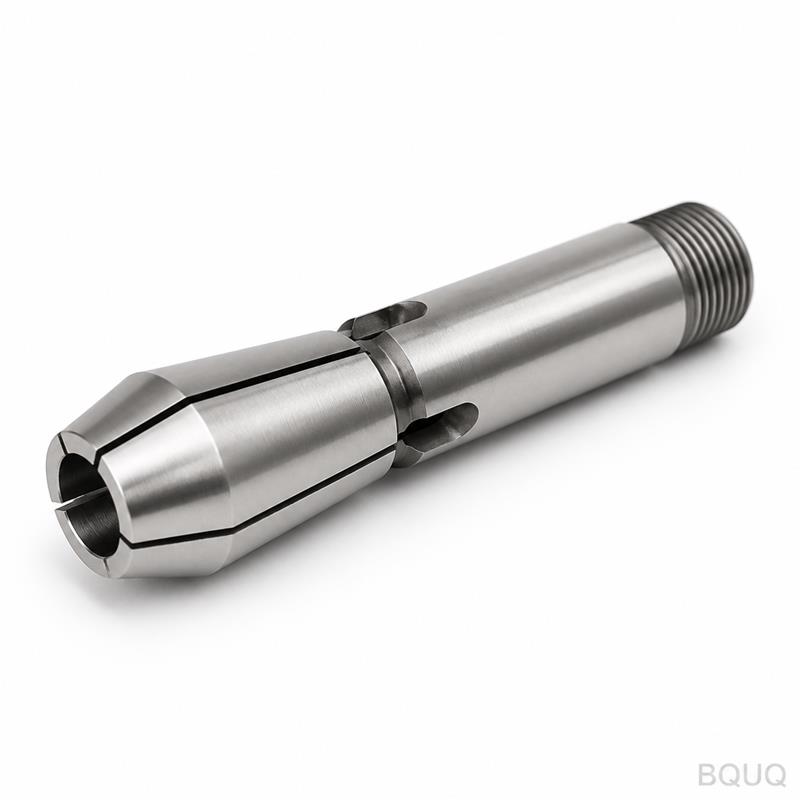
Una pinza ER es un manguito de acero ranurado que sujeta el vástago de una herramienta de corte dentro de un porta-pinzas, y es el portaherramientas de pinza más común del mundo porque está estandarizado, es económico y suficientemente bueno para la mayoría de los trabajos. El número ER es el diámetro exterior de la pinza en milímetros, la capacidad real de la pinza es su rango de sujeción, y su clase de precisión determina si sus agujeros salen redondos.
Las pinzas ER están en todas partes: en portaherramientas de fresado, mandriles de taladro, cabezales de roscado y torretas de torno. El sistema ganó esa posición al resolver el problema que las pinzas más antiguas no resolvían: una familia de pinzas, tamaños estándar, cambio rápido. Pero "ER25" solo indica el tamaño del alojamiento, no qué pinza pedir. Esta guía cubre la escalera de tamaños, qué prometen los grados de excentricidad y la lógica de selección que evita comprar la pinza equivocada dos veces.
La Escalera de Tamaños: ER8 a ER50
Las pinzas ER se nombran por su diámetro exterior: ER8 es de 8 mm de diámetro exterior, ER50 es de 50 mm de diámetro exterior, y los tamaños intermedios — ER11, ER16, ER20, ER25, ER32, ER40 — aumentan la capacidad del vástago con ello. Cada pinza sujeta un rango de diámetros de vástago, generalmente comercializado en pasos de 1 mm, por lo que una pinza ER25 marcada como de 10 mm sujeta un vástago de 10 mm y se colapsa aproximadamente medio milímetro por lado para hacerlo.
| Tamaño ER | Diámetro exterior de la pinza | Capacidad típica de vástago | Uso típico |
|---|---|---|---|
| ER8 | 8 mm | hasta ~5 mm | Taladros pequeños, grabado |
| ER11 | 11 mm | hasta ~7 mm | Fresas de punta esférica pequeñas, taladros |
| ER16 | 16 mm | hasta ~10 mm | Común en husillos de fresado |
| ER20 | 20 mm | hasta ~13 mm | Herramientas medianas |
| ER25 | 25 mm | hasta ~16 mm | El tamaño general más común |
| ER32 | 32 mm | hasta ~20 mm | Mecanizado general pesado |
| ER40 | 40 mm | hasta ~26 mm | Herramientas grandes, desbaste |
| ER50 | 50 mm | hasta ~34 mm | Herramental ER más grande |
Las capacidades son típicas para pinzas ER estándar. La conclusión: elija el alojamiento más pequeño que cubra su vástago más grande, porque las pinzas más grandes implican tuercas más pesadas, más masa para equilibrar y una contribución ligeramente mayor a la excentricidad. Si el 90% de sus herramientas tienen un vástago inferior a 16 mm, un sistema ER25 supera a un sistema ER40 en todo, excepto para ese ocasional portaherramientas grande.
Grados de Excentricidad: Qué Significan las Letras
Las pinzas ER se fabrican en clases de precisión, y la clase es una promesa sobre la excentricidad en la nariz de la pinza con una barra de prueba rectificada. Las pinzas de grado estándar típicamente alcanzan alrededor de 0.015 mm; los grados de precisión lo reducen a aproximadamente 0.005 mm o mejor en la nariz; entre ellos se encuentra el punto medio práctico utilizado por la mayoría de los talleres. El estándar internacional detrás del sistema, ISO 15488 (originalmente DIN 6499), define la geometría — el cono de 8 grados, los patrones de ranura y los métodos de prueba — mientras que los grados son una declaración de calidad de fabricación adicional.
| Grado (típico) | Excentricidad típica en la nariz | Múltiplo de precio típico | Aplicación típica |
|---|---|---|---|
| Estándar | ~0.015 mm | 1.0× | Taladrado general, desbaste, la mayoría del fresado |
| Precisión | ~0.005–0.008 mm | 1.5–3× | Acabado, agujeros más ajustados, herramientas más largas |
| Alta precisión | ~0.005 mm o mejor | 3×+ | Ultra-acabado y características críticas |
Estas son cifras típicas de la industria, no una tabla universal — cada fabricante publica sus propios valores de grado y condiciones de prueba, y la pregunta honesta es siempre "¿medido cómo y dónde?" Lo que el grado nunca promete: excentricidad en la punta de la herramienta (el vástago de la herramienta añade su propio error) o excentricidad después de años de abuso de la tuerca. Nuestra guía de grados de pinzas de precisión examina qué cubre realmente una especificación de excentricidad.
Patrones de Ranura y Colapso
Las pinzas ER estándar tienen ranuras a lo largo de su longitud para que los segmentos puedan colapsar hacia adentro. El diseño común utiliza seis ranuras, escalonadas desde cada extremo, lo que permite que la pinza se cierre uniformemente alrededor del vástago mientras permanece redonda; algunas series utilizan menos ranuras, más anchas, para ganar rango de colapso a costa de cierta uniformidad. Cuando aprieta la tuerca, el cono interno de la tuerca empuja la pinza hacia el cono del portaherramientas, comprimiendo los segmentos sobre la herramienta.
Dos reglas de selección se derivan de la mecánica. Primero, pida la pinza para el vástago, no "aproximadamente": una pinza de 10 mm en un vástago de 10 mm se colapsa aproximadamente la mitad de su rango disponible, dejando margen; una pinza de 10 mm forzada sobre un vástago de 11 mm se colapsa hasta su límite, pierde concentricidad y puede agrietarse. Segundo, use la pinza dentro de su rango diseñado — existen pinzas ER de "rango reducido" o "compactas" para vástagos que caen entre pasos estándar y ofrecen mejor excentricidad que una pinza de rango completo estirada al límite.
Par de Apriete, Tuercas y Selección Práctica
La tuerca hace un trabajo real: convierte la fuerza de la llave en la tracción axial que colapsa la pinza. Si aprieta de menos, la herramienta se sale o vibra; si aprieta de más, la pinza se esfuerza más allá de su rango de colapso, lo que se manifiesta como excentricidad. La guía de par de apriete se establece típicamente por tamaño — una tuerca ER25 comúnmente llega a aproximadamente 100–120 N·m y una tuerca ER40 más alta — pero el número a seguir es el del fabricante de su portaherramientas, no el de un vecino. Use la llave o llave dinamométrica correcta en las caras planas de la tuerca correctas; el antiadherente en las roscas de la tuerca mantiene las lecturas consistentes.
| Tamaño ER | Rango de par de apriete típico | Verificación |
|---|---|---|
| ER11 | ~20–35 N·m | Especificación del fabricante de la tuerca |
| ER16 | ~40–60 N·m | Especificación del fabricante de la tuerca |
| ER25 | ~100–120 N·m | Especificación del fabricante de la tuerca |
| ER32 | ~120–140 N·m | Especificación del fabricante de la tuerca |
| ER40 | ~140–170 N·m | Especificación del fabricante de la tuerca |
Rangos típicos, y la columna de la derecha es el punto: el diseño de la tuerca varía, así que aplique el par según el número del fabricante del portaherramientas o de la tuerca. Mantenga los conos y las pinzas limpios — un grano de viruta debajo de una pinza es un evento de excentricidad — y reemplace las pinzas que muestren ranuras agrietadas, escalones de desgaste u óxido. Las pinzas ER son consumibles con una larga vida, no reliquias.
Cuando necesite pinzas o los porta-pinzas que las asientan, mecanizados por una fábrica de origen que trata el cono de 8 grados y los asientos de localización como superficies de precisión, BQUQ mecaniza ambos a una clase de 0.005 mm en equipos CNC — trabajo del sistema ER junto con sus pinzas de muelle para torno automático bajo un mismo techo con certificación ISO9001 en Dongguan. Envíe su lista de vástagos y tamaños de portaherramientas a sc@bquq.com para una cotización dentro de 12 horas hábiles.
Preguntas Frecuentes
P: ¿Qué significa el número en ER25?
R: El diámetro exterior de la pinza en milímetros. ER25 es de 25 mm de diámetro exterior y sujeta vástagos de hasta aproximadamente 16 mm. El número identifica el tamaño del alojamiento y la familia, no la capacidad del vástago por sí sola.
P: ¿Cuánto puede colapsar una pinza ER?
R: Aproximadamente medio milímetro por lado en diseños estándar, por lo que las pinzas se escalonan en tamaños de vástago de 1 mm. El colapso es un rango de trabajo — forzar el colapso más allá de él cuesta concentricidad y arriesga agrietar la pinza.
P: ¿Pinzas ER estándar o de precisión — cuál necesito?
R: Haga coincidir el grado con la operación: estándar (clase de aproximadamente 0.015 mm) para taladrado y fresado general, precisión (aproximadamente 0.005–0.008 mm) para acabado y agujeros ajustados. Clasifique sus herramientas críticas y deje que las pinzas estándar sirvan al resto.
P: ¿Por qué mi pinza ER deja que la herramienta se salga?
R: Generalmente por bajo par de apriete de la tuerca, una pinza desgastada o aceitosa, o un vástago ligeramente por debajo del tamaño. Verifique el diámetro del vástago, limpie la pinza y el cono, y apriete la tuerca al valor del fabricante con una llave dinamométrica.
P: ¿Puede una pinza ER sujetar dos tamaños de vástago diferentes?
R: Dentro de su paso de 1 mm, efectivamente no — una pinza está hecha para un tamaño nominal de vástago y se colapsa alrededor de él. Si su vástago cae entre tamaños estándar, use la pinza estándar más pequeña o una pinza de rango reducido hecha para ese tamaño exacto.
Redactado por el Equipo de Ingeniería de BQUQ. BQUQ es una fábrica de origen certificada ISO9001 en Dongguan, China, que opera líneas de mecanizado CNC, estampado de metales, muelles personalizados, disipadores de calor y pinzas bajo un mismo techo. Envíe dibujos a sc@bquq.com o WhatsApp +86 13713157787 para una cotización dentro de 12 horas hábiles. www.bquq.com