BQUQ explica la estimación de coeficientes de convección para disipadores: rangos natural y forzado, efectos del canal entre aletas y por qué fallan las suposiciones de las hojas de datos.
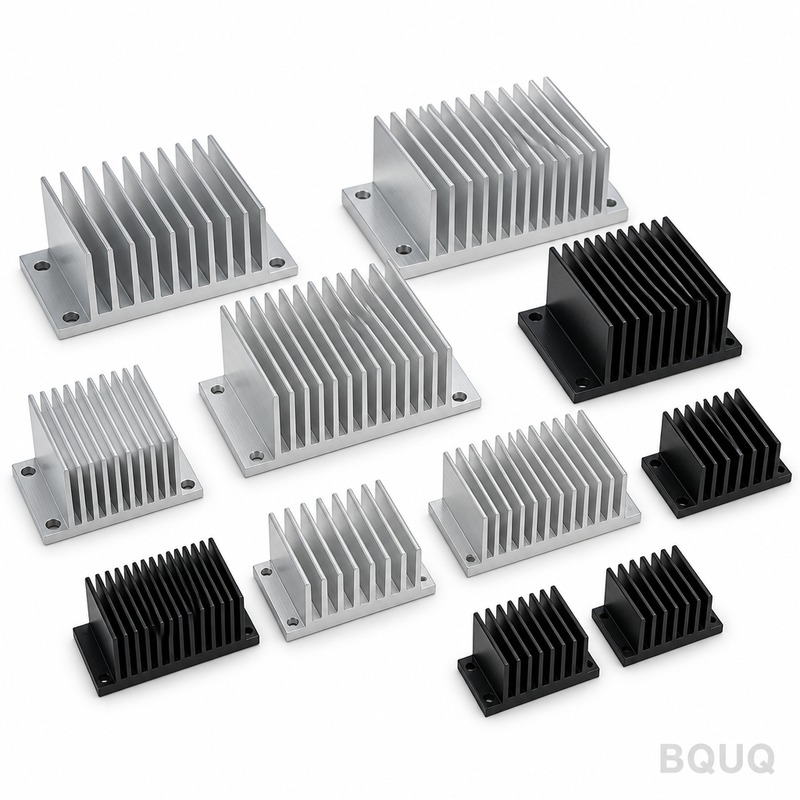
Estimación de coeficientes de convección: de la hoja de datos a la realidad
Respuesta breve: planifique con h ≈ 3–8 W/m²·K para convección natural desde un disipador, 10–30 W/m²·K para un flujo suave de ventilador a 1–2 m/s, 30–80 W/m²·K para flujo de aire canalizado a 3–5 m/s, y por encima de 100 W/m²·K solo con flujo de alta velocidad o por impacto. El coeficiente no es una propiedad del material: depende de la geometría de las aletas, el ancho del canal, la velocidad del aire, la orientación y la temperatura. La mayoría de los errores de diseño se remontan a usar un h optimista para todo el disipador, cuando el valor real varía desde la raíz hasta la punta de la aleta y desde el canal hasta el aire de derivación.
Cada cálculo de disipador térmico se apoya en el coeficiente de convección h, y h es el número menos seguro en el diseño térmico. También es el más mal utilizado: las hojas de datos lo citan, las hojas de cálculo lo asumen, y las simulaciones emplean miles de celdas para calcularlo, sin embargo, una sorprendente proporción de fallos térmicos se remonta a un h incorrecto usado con matemáticas perfectas. Este artículo trata sobre estimar h con honestidad, desde los rangos de los libros de texto hasta la realidad de un canal entre aletas dentro de su recinto.
Los rangos que delimitan la realidad
El coeficiente de convección describe cuántos vatios salen de cada metro cuadrado de superficie por grado de diferencia de temperatura. Su rango entre métodos de enfriamiento abarca más de tres órdenes de magnitud, por lo que la misma carga térmica puede necesitar un disipador del tamaño de la palma de la mano o un gabinete lleno de aletas. El aire es un fluido de transferencia de calor pobre: su conductividad y densidad son bajas, por lo que incluso un movimiento vigoroso del aire entrega mucho menos que cualquier líquido.
| Modo de enfriamiento | Velocidad del aire | Rango típico de h | Cómo se percibe |
|---|---|---|---|
| Convección natural, aire en reposo | ~0.1–0.5 m/s (flotabilidad) | 2–8 W/m²·K | Disipador pasivo, silencioso |
| Convección natural con radiación | — | +20–40% efectivo | Disipadores anodizados en negro |
| Ventilador suave, aire libre | 1–2 m/s | 10–30 W/m²·K | Ventilador axial pequeño, carcasa holgada |
| Ventilador canalizado a través de aletas | 2–4 m/s | 25–60 W/m²·K | Disipador con carcasa, presión estática real |
| Conducto de alta velocidad o impacto | 5–10 m/s | 60–150 W/m²·K | Aplicaciones de servidor o soplador |
| Placa fría líquida | — | 1,000–10,000 W/m²·K | Canales de refrigerante bombeado |
Use la mitad del rango para la planificación y el extremo inferior para el peor caso. El error más común es tratar el extremo optimista como punto de diseño, que es como "la hoja de datos dice que este disipador disipa 100 W" se convierte en un fallo en campo a 60 W cuando el ventilador real solo empuja 1 m/s de aire mal canalizado.
Por qué el h de convección natural es tan inestable
La convección natural no tiene ventilador que la estabilice, por lo que todo se desvía. La fuerza motriz es la flotabilidad: el aire caliente asciende desde las aletas, y h depende de la propia diferencia de temperatura, aproximadamente h ∝ ΔT^0.25 para una placa vertical. Duplicar el aumento de temperatura hace que h crezca alrededor de un 19%, lo que significa que el coeficiente mejora exactamente cuando el disipador está más caliente — una retroalimentación que aplana la curva de temperatura y rompe la suposición de que Rth es constante.
La orientación cambia la convección natural más de lo que la mayoría espera. Una placa vertical con aire libre en ambos lados alcanza su coeficiente más alto, aproximadamente 3–8 W/m²·K a temperaturas típicas de electrónica. La misma placa horizontal, con el lado caliente hacia arriba, pierde 10–30%; horizontal con el lado caliente hacia abajo, como cuando un módulo se asienta sobre un disipador montado en un estante, puede perder 30–50% porque la superficie caliente atrapa una capa de aire estancado. Los canales entre aletas añaden otro efecto: los canales estrechos fusionan las capas límite y ahogan el flujo de flotabilidad, por lo que los disipadores de convección natural necesitan un paso amplio. Nuestra comparación de convección natural versus forzada muestra las consecuencias prácticas para elegir la arquitectura de enfriamiento.
Convección forzada: la velocidad no lo es todo
El flujo de aire forzado eleva h, pero solo cuenta el aire que realmente se mueve a través de los canales entre aletas. Tres efectos separan el h de la hoja de datos del h real. Derivación: el aire toma el camino de menor resistencia alrededor del bloque de aletas, por lo que un ventilador que sopla hacia un disipador en aire libre puede empujar la mayor parte de su flujo más allá de las aletas, no a través de ellas; las carcasas y conductos solucionan esto. Efectos de entrada: los primeros centímetros de un canal entre aletas tienen capas límite delgadas y un h local alto, mientras que aguas abajo el flujo se desarrolla y h cae; en canales cortos, todo el canal se comporta como una región de entrada, lo cual es favorable pero generalmente se ignora en estimaciones simples. Turbulencia: los flujos reales de ventilador son turbulentos y mezclan, lo que eleva h muy por encima de las correlaciones laminares que usan los ejemplos de los libros de texto.
| Velocidad del aire a través del canal | Estimación casi laminar | Valor realista canalizado |
|---|---|---|
| 1 m/s | 10–15 W/m²·K | 10–25 W/m²·K |
| 2 m/s | 15–25 W/m²·K | 20–40 W/m²·K |
| 3 m/s | 20–35 W/m²·K | 30–60 W/m²·K |
| 5 m/s | 30–50 W/m²·K | 50–100 W/m²·K |
La brecha entre columnas es juicio de ingeniería, no precisión, por lo que los diseños serios miden. El camino de medición — construir el disipador, hacer funcionar el ventilador, medir el flujo de aire y las temperaturas — convierte estas estimaciones en un coeficiente real, como se describe en nuestra guía de pruebas térmicas de disipadores. Las estimaciones dimensionan el proyecto; las mediciones lo cierran.
Cómo usar h sin engañarse a sí mismo
La disciplina que salva la mayoría de los diseños es usar h como un rango, no como un número, y llevar ese rango a través de todo el cálculo. Ejecute el presupuesto de resistencia térmica dos veces: una con su h optimista y otra con el pesimista. Si ambas respuestas caben en su presupuesto de temperatura, el diseño es robusto y puede proceder al prototipado. Si solo cabe el caso optimista, el diseño es una apuesta disfrazada de estimación, y es más barato añadir área de aletas, flujo de aire o un ventilador ahora que reelaborar después de las pruebas térmicas.
También aplique h donde corresponde. Las aletas cerca de la base ven el aire más rápido y el metal más caliente; las puntas de las aletas y la mitad de sotavento del disipador ven un flujo degradado. Usar un h promedio en toda la superficie es aceptable para dimensionamiento rápido solo si el promedio es conservador. Para convección natural, recuerde la radiación: un disipador anodizado en negro con un aumento de 50 °C rechaza aproximadamente 20–40% de su calor por radiación, lo que se comporta como un h adicional que los números de convección pura pasan por alto. Esa es una razón por la que los disipadores mecanizados anodizados superan mediblemente al aluminio desnudo en aplicaciones pasivas, aunque el anodizado apenas cambia la conducción.
Cómo deberían verse los datos térmicos de un buen proveedor
Los datos térmicos del proveedor merecen el mismo escrutinio que las estimaciones de este artículo. Un número de resistencia sin condiciones no es un dato: la cotización o la hoja de datos debe indicar la velocidad del aire o la configuración del ventilador, el ambiente, el tamaño de la fuente de calor y si la cifra incluye un TIM. Cualquier cosa medida debe decir cómo: un túnel de viento a una velocidad frontal declarada, una prueba con montaje de ventilador en una carcasa declarada, o una prueba en cámara de convección natural en una orientación declarada. Cuando dos proveedores cotizan la misma pieza, compare las condiciones antes de comparar los números, porque un disipador cotizado a 5 m/s de aire canalizado no se comportará igual en su recinto a 1 m/s.
Pregunte cómo se derivó el número, medido o simulado. Los valores medidos conllevan la incertidumbre de ±5–10% del equipo; los valores simulados conllevan las suposiciones de condiciones de contorno del modelo, a menudo ±10–20%. Ambos son legítimos si se etiquetan, y ambos son peligrosos si no. Un proveedor que presenta una simulación como medición, u omite por completo el flujo de aire, no es necesariamente deshonesto, pero los datos no se pueden usar para su diseño, y la respuesta educada es solicitar el protocolo de prueba.
La pregunta más útil que puede hacer a una fábrica de disipadores es más simple que cualquiera de estas: ¿qué necesita de mí para dimensionar esto correctamente? La respuesta debe incluir vatios, huella de la fuente, ambiente, aumento permitido o temperatura objetivo, y el plan de flujo de aire. Un proveedor que hace esas preguntas está ejecutando el cálculo basado en h como describe este artículo; un proveedor que cotiza a partir de una foto está poniendo precio al metal. La diferencia se nota en la primera prueba térmica, y es mucho más barato descubrirlo en la etapa de cotización que después del utillaje.
En BQUQ cotizamos disipadores con las condiciones declaradas: el flujo de aire asumido, la resistencia resultante y el mecanizado que hace real la interfaz, con caras críticas mantenidas a ±0.005 mm. Como mecanizamos, combinamos extrusión y acabado en una sola planta en Dongguan, los datos térmicos que recibe están vinculados a la pieza que realmente enviamos. Envíe los vatios, la huella, el ambiente y el flujo de aire a sc@bquq.com o WhatsApp +86 13713157787, y la cotización declarará sus propias suposiciones en 12 horas laborables.
Preguntas frecuentes
P: ¿Cuál es un coeficiente de convección típico para convección natural?
R: Para superficies verticales y disipadores en aire en reposo, planifique con h ≈ 3–8 W/m²·K a temperaturas típicas de electrónica, variando con el aumento de temperatura, el tamaño y la orientación. La radiación añade un enfriamiento efectivo del 20–40% en superficies oscuras de alta emisividad.
P: ¿Qué coeficiente de convección debo usar para un disipador enfriado por ventilador?
R: Depende de la velocidad del aire a través de los canales entre aletas: aproximadamente 10–30 W/m²·K a 1–2 m/s, 25–60 W/m²·K a 2–4 m/s de flujo canalizado, y más alto con sopladores o impacto. Use el extremo inferior de su rango para un diseño de peor caso.
P: ¿Por qué mi disipador real es peor que mi cálculo basado en h?
R: Porque el flujo de aire real es menor que el asumido, o se derivó completamente alrededor de las aletas. Los ventiladores entregan menos flujo a través de campos de aletas densos que su clasificación a aire libre, y las configuraciones de ventilador a aire libre empujan gran parte del flujo alrededor del disipador. Encapsule el disipador y mida la velocidad real del canal.
P: ¿Cómo obtengo un h preciso para mi disipador específico?
R: Mídalo: aplique una potencia conocida, haga funcionar su configuración real de ventilador, mida el aumento de temperatura de la base en estado estacionario y recalcule h a partir del área de aletas y la eficiencia. Ese valor medido, no el número del libro de texto, es lo que pertenece a su modelo térmico.
P: ¿Puede BQUQ ayudar a convertir estas estimaciones en hardware?
R: Sí. Envíe sus vatios, plan de flujo de aire y presupuesto de temperatura a sc@bquq.com o WhatsApp +86 13713157787, y mecanizaremos un prototipo de disipador según su geometría — extruido o CNC — dentro de las 12 horas laborables posteriores a la cotización, para que pueda medir el coeficiente real en lugar de estimarlo.
Recursos relacionados
- Disipadores de convección natural vs forzada — elegir la arquitectura antes de estimar h.
- Cálculo de resistencia térmica de disipadores — el presupuesto que convierte h en un tamaño de disipador.
- Cálculo de dimensionamiento de disipadores — llevar el rango de h a través de un ejemplo completo de dimensionamiento.
- Contáctenos — envíe su plano para una cotización en 12 horas laborables.
Autoría del equipo de ingeniería de BQUQ. BQUQ es una fábrica de origen certificada ISO9001 en Dongguan, China, que opera líneas de mecanizado CNC, estampado de metal, muelles personalizados, disipadores y pinzas bajo un mismo techo. Envíe planos a sc@bquq.com o WhatsApp +86 13713157787 para una cotización en 12 horas laborables. www.bquq.com