Mecanizado CNC de 3 ejes frente a 4 ejes frente a 5 ejes: diferencias clave explicadas
3-Axis vs 4-Axis vs 5-Axis CNC Machining: Key Differences Explained
**Direct Answer:** The primary difference lies in the number of axes of simultaneous motion. 3-axis machines move the cutting tool linearly along X, Y, and Z planes, ideal for flat or prismatic parts. 4-axis adds a rotating table (A-axis) around the X-axis, enabling machining of cylindrical features without re-fixturing. 5-axis machines add two rotational axes (typically A and C), allowing the tool to approach the workpiece from any direction, achieving complex geometries, superior surface finishes, and tighter tolerances in a single setup.
---
1. The Evolution of CNC Axes: From Simple to Complex
CNC (Computer Numerical Control) machining has evolved from basic manual mills to highly sophisticated multi-axis centers. Understanding the axis configuration is fundamental to selecting the right process for your part geometry, production volume, and budget.
- **3-Axis:** The workhorse of the industry. The spindle moves in three linear directions (X, Y, Z). The workpiece remains stationary on the table. It is the most cost-effective and widely used method for parts with flat bases, drilled holes, and simple contours. - **4-Axis:** Adds a rotary axis (usually the A-axis, rotating around X). This allows for machining features on the sides of a part without manual repositioning. Common applications include camshafts, impellers, and curved slots. - **5-Axis:** Incorporates two rotary axes (typically A and C). This enables complex undercuts, angled holes, and sculpted surfaces in a single fixture. Crucially, it allows the tool to maintain an optimal cutting angle, reducing tool deflection and improving surface finish.
---
2. Machining Capabilities and Geometric Limits
The axis count directly dictates the geometric complexity you can achieve. Here is a breakdown of what each system can physically do:
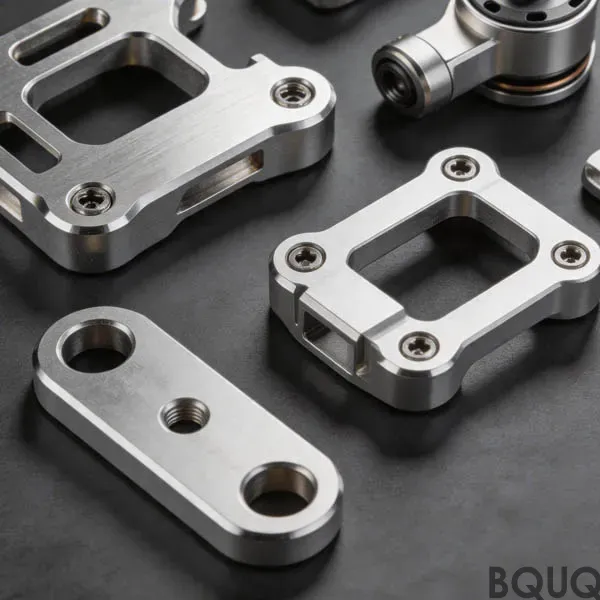
**3-Axis Capabilities:** - Flat surfaces, straight slots, and simple 2D/2.5D profiles. - Drilling, tapping, and reaming perpendicular to the top face. - Limited to machining features accessible from a single direction unless the part is manually re-clamped, which introduces human error and increases lead time.
**4-Axis Capabilities:** - All 3-axis features, plus continuous machining around a cylindrical axis. - Engraving on curved surfaces, helical milling, and indexing for multiple faces. - Ideal for parts that require machining on 3 or 4 distinct faces without a custom fixture.
**5-Axis Capabilities:** - Full contouring of complex 3D surfaces (e.g., turbine blades, molds). - Machining undercuts and deep cavities with short, rigid tools (minimizing vibration). - Drilling holes at compound angles in a single setup.
**Table 1: Geometric Complexity vs. Axis Count**
| Feature Type | 3-Axis | 4-Axis | 5-Axis | :--- | :---: | :---: | :---: | Flat Face Milling | Yes | Yes | Yes | 2D Pockets & Holes | Yes | Yes | Yes | Cylindrical Slotting | No | Yes | Yes | Helical Grooves | No | Yes | Yes | Compound Angle Holes | No | No (Index only) | Yes | Sculpted Freeform Surfaces | No | Limited | Yes | Deep Undercuts | No | No | Yes |
|---|
---
3. Tolerance, Surface Finish, and Cycle Time Data
Machining accuracy is not solely about the machine's resolution; it's about rigidity, tool path strategy, and the number of setups. Multiple setups on a 3-axis machine accumulate positioning errors. A 5-axis machine eliminates these errors by machining the part in one clamping.
**Real-world data from BQUQ production floor (Dongguan, China):**
- **3-Axis:** Standard tolerance is ±0.005 mm (0.0002 in) for linear dimensions. Surface finish achievable is typically Ra 0.8 µm (32 µin) standard, down to Ra 0.4 µm (16 µin) with fine cutting parameters. Cycle time is longer for complex parts due to multiple manual re-fixturings. - **4-Axis:** Tolerances remain at ±0.005 mm for linear, but rotational positioning accuracy is ±0.01 degrees. This reduces setup time by 20-30% for cylindrical parts compared to 3-axis with rotary attachments. - **5-Axis:** Can hold ±0.003 mm (0.00012 in) on complex contours due to reduced tool deflection and consistent cutting geometry. Surface finish can be pushed to Ra 0.2 µm (8 µin) on aluminum alloys. Cycle time reduction is significant—often 40-50% faster than 3-axis for complex parts, as it eliminates multiple setups and uses shorter, more rigid tools.
**Table 2: Comparative Performance Metrics (Milling Aluminum 6061-T6)**
| Metric | 3-Axis | 4-Axis | 5-Axis | :--- | :--- | :--- | :--- | Positioning Tolerance (Linear) | ±0.005 mm | ±0.005 mm | ±0.003 mm | Rotational Tolerance | N/A | ±0.01° | ±0.005° | Best Surface Finish (Ra) | 0.4 µm | 0.4 µm | 0.2 µm | Typical Setup Time (Complex Part) | 45 min | 30 min | 15 min | Machining Time (Turbine Blade, 100mm) | 90 min (2 ops) | 70 min (1 op) | 45 min (1 op) | Relative Cost per Hour (Machine) | $60 - $80 | $80 - $100 | $120 - $150 |
|---|
*Note: Costs vary based on machine brand and region. Data reflects standard 3-axis VMC, 4-axis with rotary table, and 5-axis trunnion machine.*
---
4. Cost Analysis: Machine Hourly Rates vs. Total Part Cost
The initial capital expenditure (CAPEX) and hourly operating costs escalate sharply with axis count. However, the total cost per part can be lower on a 5-axis machine for complex geometries because it consolidates operations.
- **3-Axis Machine Cost:** Entry-level VMCs start at ~$40,000. Operational cost is lower, but labor cost for setups is higher. - **4-Axis Machine Cost:** Adding a rotary table to a 3-axis machine increases cost by $10,000–$20,000. A dedicated 4-axis machine starts at ~$70,000. - **5-Axis Machine Cost:** High-precision 5-axis machining centers start at $150,000 and can exceed $500,000 for large-format or high-speed models.
**The Hidden Cost of Fixtures:** A 3-axis process for a complex part may require 3-4 custom fixtures (each costing $500-$2,000). A 5-axis process often requires only one simple vise or a single custom fixture, saving significant upfront tooling costs for medium-to-high volume production.
---
5. Thermal Effects and Material Considerations
Multi-axis machining generates heat, which affects both the tool and the workpiece. 5-axis machines often feature better thermal compensation systems to handle the added stress of rotational axes.
- **Heat Generation:** At high spindle speeds (e.g., 15,000 RPM), aluminum machining generates substantial heat. 5-axis machines, with their ability to keep the tool engaged at optimal angles, can reduce heat concentration by 15-20%, extending tool life by up to 30% compared to 3-axis operations on the same material. - **Material Suitability:** - **3-Axis:** Ideal for all materials, but particularly cost-effective for aluminum, brass, and mild steel. - **4-Axis:** Excellent for cylindrical parts in stainless steel and titanium, where continuous cutting reduces work hardening. - **5-Axis:** Essential for aerospace-grade titanium and Inconel, where the ability to use a short tool with a tilted head reduces chatter and maintains material integrity.
---
6. Practical Recommendations for Part Design and Sourcing
Choosing the right axis configuration is a critical engineering decision. Here is a practical guideline:
1. **Rule of Thumb for 3-Axis:** If your part is a bracket, a plate, or a housing with features only on the top and bottom, and you can tolerate a secondary operation for side holes, use 3-axis. It is the most economical. 2. **Rule of Thumb for 4-Axis:** If your part is cylindrical or needs precise features on 3 or 4 sides, such as a manifold or a shaft, choose 4-axis. It is the sweet spot for "indexing" work (rotating to a fixed angle) without the programming complexity of full 5-axis. 3. **Rule of Thumb for 5-Axis:** If your part has complex curves, angled features, or requires "machining to net shape" in a single setup, invest in 5-axis. This is critical for medical implants, aerospace components, and complex molds.
**Do not over-specify.** Using 5-axis for a simple flat part is a waste of capital and programming time. Conversely, forcing a 3-axis machine to do a 5-axis job will result in poor tolerances and high costs from multiple setups.
---
7. FAQ-Style Tips for Engineers
**Q: What is the primary cause of tolerance loss in 3-axis vs 5-axis?** A: Fixture stack-up error. Each time you re-clamp a part on a 3-axis machine, you introduce a positional error of 0.01-0.02 mm. 5-axis eliminates this.
**Q: Can a 4-axis machine do everything a 5-axis can?** A: No. A 4-axis machine rotates only around one axis. A 5-axis machine rotates around two. This means a 4-axis cannot machine a compound angle (an angle relative to two planes) without special tooling.
**Q: How does machining temperature affect multi-axis choice?** A: For high-temp alloys (Inconel, Titanium), 5-axis's ability to keep the tool cutting at a consistent chip load reduces heat buildup, preventing work hardening and premature tool failure. Expect 20-30% longer tool life on 5-axis for these materials.
**Q: Is 5-axis programming significantly harder?** A: Yes. 3-axis programming is standard G-code. 5-axis requires CAM software with collision detection and post-processors that handle the machine's specific kinematic structure. Programming time can be 2-3 times longer for 5-axis.
---
Conclusion: Matching the Machine to the Part Geometry
The difference between 3, 4, and 5-axis CNC machining is not simply about "more axes = better." It is about matching the machine's kinematic capability to the part's geometric complexity and tolerance requirements. For simple prismatic parts, 3-axis is the efficient, low-cost champion. For cylindrical components, 4-axis offers a robust middle ground. For complex, high-precision 3D contours, 5-axis is the only viable solution that delivers accuracy, surface finish, and throughput in a single setup.
At BQUQ, we operate a full fleet of 3-axis, 4-axis, and 5-axis CNC machines, allowing us to recommend the most cost-effective manufacturing strategy for your specific drawing. We provide DFM feedback within hours, not days.
**Need a quote?** Send us your CAD files today. We provide detailed engineering feedback and a 12-hour quoting turnaround. Contact our engineering team at **sc@bquq.com** or via WhatsApp at **+86 13713157787**. Visit our website at **www.bquq.com** to learn more about our precision manufacturing capabilities.